If you have been putting off dental work because the idea of being sedated makes you nervous, the single most important question to ask any office is not whether they offer IV sedation. It is who actually administers and monitors that sedation while the dentist is working. At our Longview and Tyler offices, the answer is a full-time, in-house Certified Registered Nurse Anesthetist (CRNA) whose only job during your visit is your safety.
That arrangement is more unusual than most patients realize, and it is one of the biggest reasons people drive in for sedation dentistry from across East Texas. Here is what a CRNA does, why having one in-house matters, and how it changes the experience of getting dental implants or full-mouth treatment.
What Is a CRNA, and What Do They Actually Do?
A Certified Registered Nurse Anesthetist is a master's-level advanced practice nurse trained in the same airway management and pharmacology principles used in hospital operating rooms. CRNAs administer anesthesia for millions of procedures every year. In a dental setting, the CRNA starts your IV, carefully titrates your sedation medication to your body and your procedure, and continuously watches your breathing, heart rate, blood pressure, and oxygen levels from the moment you arrive until you are safely awake.
The key word is continuously. Sedation is safest when one trained professional is responsible for nothing but the patient's vital signs, while a separate professional performs the dentistry. That separation of roles is the standard in a hospital, and it is exactly the model our Longview and Tyler offices follow.
In-House vs. Outsourced: The Difference Most Patients Never Hear About
Many dental practices that advertise IV sedation do not have a dedicated anesthesia provider on staff. Instead, they either schedule an outside CRNA or anesthesiologist to visit on certain days, or they ask the treating dentist to monitor your sedation while also performing your procedure. Both approaches have real drawbacks.
When anesthesia is outsourced, your sedation appointment depends on an outside provider's schedule, and the person managing your airway may be meeting you for the first time that morning. When the dentist monitors sedation while operating, one person is splitting attention between your treatment and your vital signs at the very moment both demand full focus.
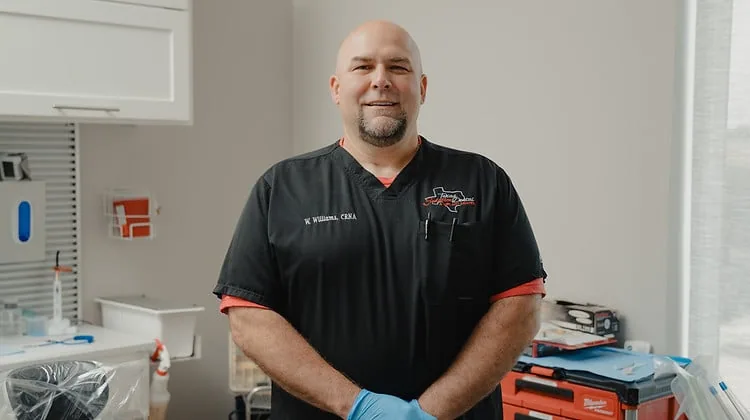
Our CRNA, Waylon Williams, is part of our team, in the building, focused solely on your sedation and safety. He reviews your medical history ahead of time, knows our doctors and our protocols, and is there for the entire visit, not just a scheduled window. For complex, longer appointments like All-on-4 and full-arch implant cases, that continuity is exactly when it matters most.
Why This Matters for Implant and Full-Mouth Patients
Procedures like full-arch implants or The Ultimate Smile in 24 Hours involve longer appointments. Comfortable, well-managed sedation is what allows a patient to rest through a lengthy surgical visit rather than white-knuckling the chair. With a CRNA managing sedation, our doctors can stay fully focused on the precision of the surgery, and you can wake up with the hardest part behind you.
It also opens the door for patients who have avoided dentistry for years because of fear, a strong gag reflex, or complex medical histories. A CRNA can adjust dosing for age, weight, and health conditions, and coordinate with your physician when needed, so that sedation remains appropriate even for older patients or those managing common cardiac and blood pressure medications.
Questions Worth Asking Any Sedation Dentist
- Who administers and monitors my IV sedation, and is that person on staff or brought in from outside?
- Is the person watching my vital signs different from the person performing my dental work?
- What training does your anesthesia provider have, and are they a CRNA or an anesthesiologist?
- Will my sedation provider review my medical history and medications before the day of treatment?
If an office cannot answer those questions clearly, that is worth knowing before you commit. At our Longview and Tyler locations, the answers are simple: a dedicated, in-house CRNA, separate from the treating dentist, who reviews your history in advance and monitors you the entire visit.
Schedule a Sedation Consultation
If dental anxiety or a complex case has kept you out of the chair, sedation dentistry with a dedicated CRNA may be the difference that finally lets you move forward. Contact our team to schedule a complimentary consultation and ask about sedation options at the location nearest you. We will review your health history, explain your choices, and build a plan around your comfort and safety.