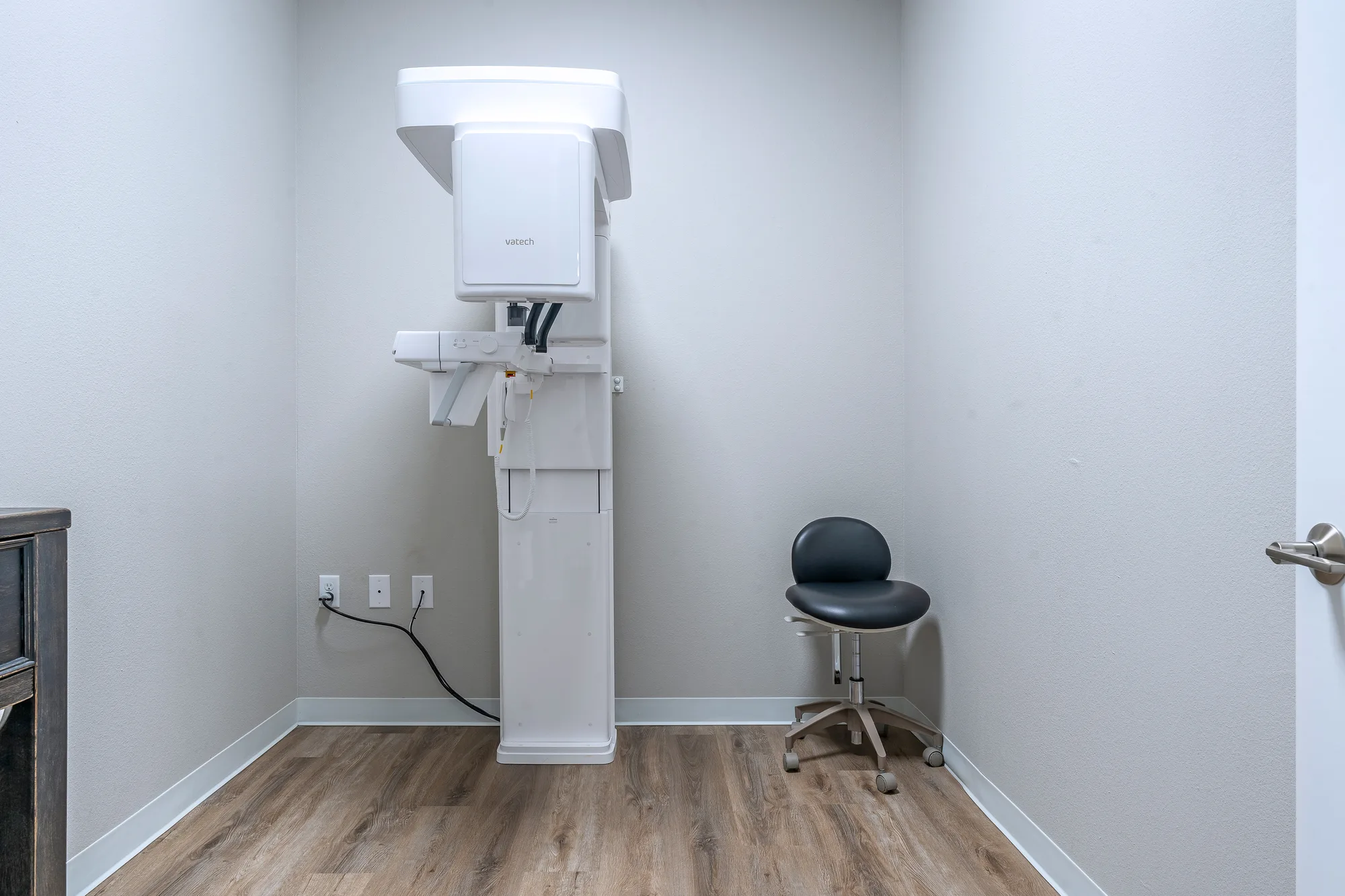
Every implant case at our office starts the same way: with a 3D X-ray, called a CBCT scan, taken right here in the office. But what is Dr. Kendall actually looking at when your scan opens on the screen? In a recent video, he walked through his mental checklist for the first 60 seconds, and it says a lot about how dental implant surgery should be planned.
Watch: What We Look For in Your 3D X-Ray
First: The Structures We Have to Protect
The first thing Dr. Kendall locates is the mental nerve, the nerve that exits the lower jaw near your chin and gives feeling to your lip. Implant surgery has to avoid that nerve, so knowing exactly where it runs is non-negotiable. Next come your sinuses: where they sit and how far forward they come, since they define how much room is available for implants in the upper jaw.
Second: Your Bone, in Three Dimensions
Then it is all about bone. Do you have enough thickness? Enough width and length? Is there an area where bone has decreased over the years? A 3D scan answers questions a flat X-ray never could, which is why we never plan implants without one. Dr. Kendall also evaluates the bone in your cheekbones, called the zygomatic bones, and a bone at the back of your mouth called the pterygoid bone, because for patients with severe bone loss, those areas give an experienced surgeon additional places to anchor a smile.
Third: Signs of Trouble
The scan also reveals what is going wrong today: infections around the teeth, hidden decay, and areas of bone loss you may not feel yet. Catching those early matters, because infections and bone loss shape which treatment path makes sense and how urgently it should happen.
It's Never "Can We?" — It's "Which Tools?"
Here is the mindset behind that 60-second read. As an implant surgeon, Dr. Kendall has a deep bag of tools: standard placement, advanced techniques, grafting, and anchor points like the zygomatic and pterygoid bones for the hardest cases.
It's never 'can I get you a smile.' It's 'what tools do I have to take out of my bag to be able to get you the smile of your dreams.' We call it the Ultimate Smile.
That is the real purpose of the scan: not to decide whether you can be helped, but to map out exactly what it will take to deliver the Ultimate Smile for your specific anatomy.
See Your Own Scan in Longview, Tyler, or Shreveport
The best way to understand your options is to look at your own anatomy on the screen with a surgeon beside you. At Texas Sedation Dental & Implant Center, your complimentary Ultimate Smile Assessment, a $500 value, includes the 3D CBCT scan, and your fixed smile is backed by our Love Your Smile Money Back Guarantee. Schedule yours today and find out what the first 60 seconds of your scan reveals.