
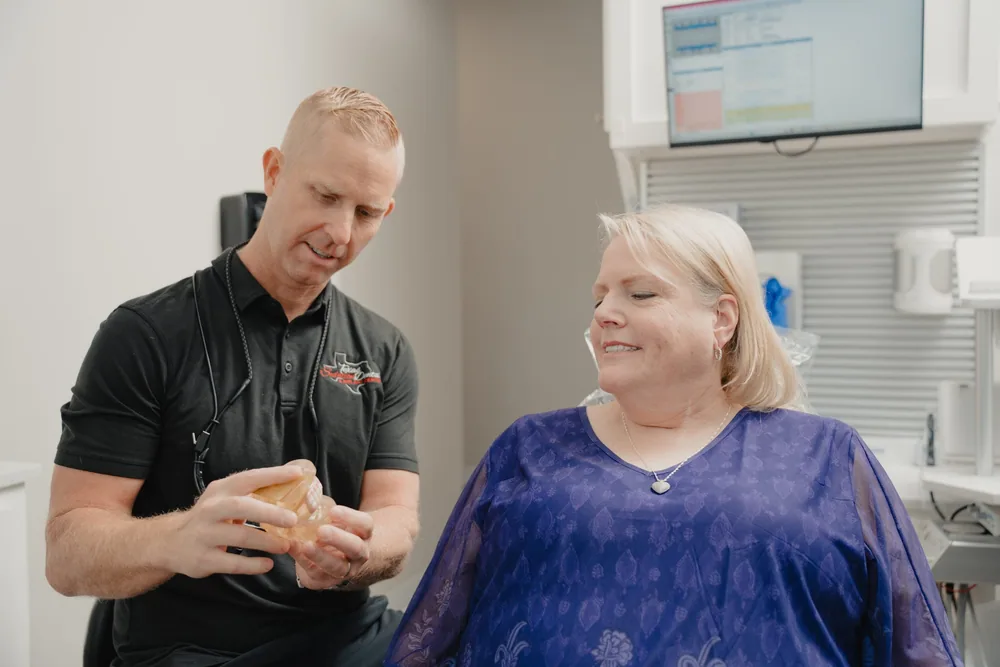
If you clench or grind your teeth, you may wonder whether that habit follows you into a new smile. In a recent video, Dr. Kendall answered it directly: yes, clenching or grinding on a full mouth of dental implants can compromise their long-term health. The good news is that it can be measured, managed, and protected against, and that is exactly what we build into every Ultimate Smile.
Watch: Can My Implants Fail If I Grind or Clench My Teeth?
Why Grinding Is Hard on Implants
Natural teeth sit in a thin, cushioning ligament that gives a little under pressure and tells your brain when you are biting too hard. Implants fuse directly to the jawbone, so there is far less give. That rigid connection is what makes implants so strong for chewing, but it also means the heavy, repeated force of nighttime grinding goes straight into the teeth, the screws that hold them, and the bone around the implants.
Over time, uncontrolled grinding and clenching can lead to:
- Chipped or fractured implant teeth
- Loosened or broken screws and other components
- Extra stress on the bone that supports each implant
- In the worst cases, implant failure
Many grinders don't know they do it. Common clues include teeth that look shorter or flatter than they used to, a sore jaw or headache when you wake up, or a partner who hears you grinding at night. Grinding can also wear your bite down until your face loses some of its height, something Dr. Kendall covered in another video.
How We Measure Your Bite With T-Scan
Traditionally, dentists check a bite with colored bite paper. It marks where teeth touch, and the dentist makes small adjustments from there. The paper shows where teeth meet, but not how hard or in what order.
Here in our office, we have invested in technology called T-Scan. It measures your bite force and where you are biting hardest, so instead of guessing from paper marks, a computer shows exactly which spots are hitting hard and which are hitting softer. We use that information to dial in your bite and balance the force across your whole smile. (T-Scan is also part of how we help patients with jaw pain and bite problems.)
Instead of just using bite paper that marks on the teeth and making little adjustments, we're actually having a computer diagnose exactly where you're hitting hard and where you're hitting softer.
A Night Guard for the Hours You Can't Control
Even a perfectly balanced bite can't stop you from grinding in your sleep. That is why, on top of fine-tuning your bite, we provide a night guard so your new teeth are protected from grinding and clenching forces while you sleep. Wear it every night, keep it clean, and bring it to your checkups so we can make sure it still fits well.
Do Grinders Still Qualify for Implants?
Grinding is something to plan around, not usually a reason to give up on fixed teeth. During your evaluation, your doctor looks at wear on your teeth, your jaw, and your bite, and factors that into how your new smile is designed, built, and protected. The goal Dr. Kendall described is simple: the best bite possible, to prevent fractures, breakage, and implant failure from grinding or clenching.
Protecting Your Smile in Longview, Tyler, and Shreveport
At Texas Sedation Dental & Implant Center, bite analysis and nighttime protection are part of how we help The Ultimate Smile in 24 Hours last. If you grind or clench and you're considering implants, tell us at your visit so we can plan for it from day one. Schedule your complimentary Ultimate Smile Assessment, a $500 value that includes a 3D CBCT scan.


